
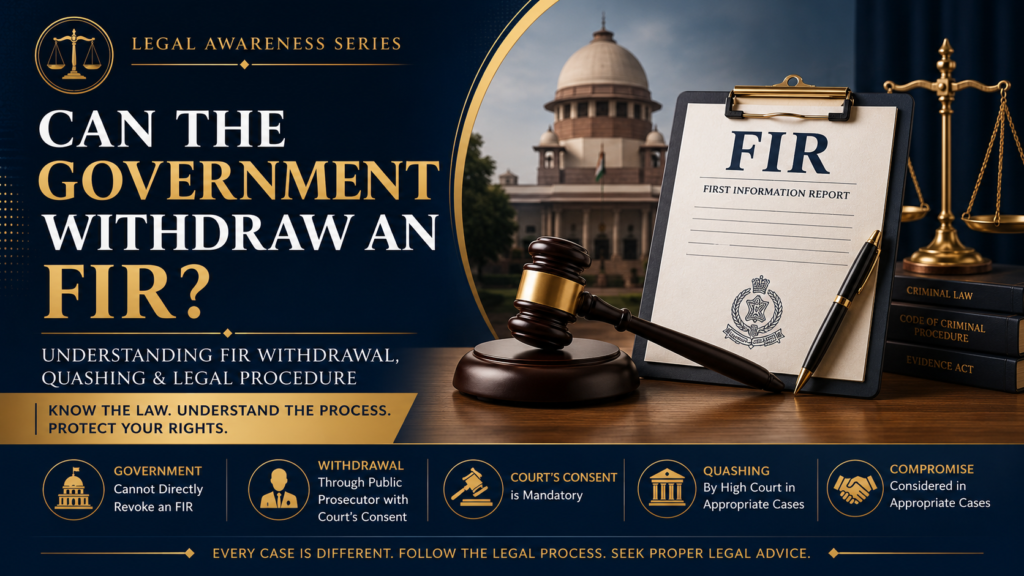
Can the Government Withdraw an FIR? Understanding the Legal Position
Legal Awareness Newsletter | Criminal Law
When an FIR is registered, many people believe that the Government can simply withdraw, revoke, or cancel it through an administrative order. However, the legal position is more nuanced.
An FIR is the First Information Report that sets the criminal justice process in motion. It is not ordinarily treated as a document that can be withdrawn or revoked at the discretion of the Government. The subsequent legal process depends on the nature of the offence, the stage of the proceedings, the findings of the investigation, and the powers of the competent court.
Can the Government Directly Withdraw an FIR?
Generally, the Government cannot directly erase, revoke, or cancel an FIR merely by issuing an administrative order.
Once an FIR has been registered, the matter enters the criminal justice system. The investigation is conducted by the competent investigating agency, and judicial authorities may become involved at different stages.
Therefore, it is important to distinguish between:
- Closure or cancellation of a case after investigation
- Quashing of an FIR by the High Court
- Withdrawal from prosecution through the Public Prosecutor
- Compromise or settlement between the parties in appropriate cases
These are different legal mechanisms and should not be used interchangeably.
What Is Withdrawal from Prosecution?
Under Section 360 of the Bharatiya Nagarik Suraksha Sanhita, 2023 (BNSS), the Public Prosecutor or Assistant Public Prosecutor may, with the consent of the court, withdraw from the prosecution of a person before the judgment is pronounced.
This process is commonly referred to as withdrawal from prosecution.
However, it is important to understand that:
Withdrawal from prosecution is not the same as cancellation or revocation of an FIR.
The Public Prosecutor performs a statutory role in the criminal justice system. Although the Government may have a role in matters of public policy and administration, the withdrawal process must follow the procedure prescribed by law and remains subject to judicial scrutiny.
Is the Court’s Consent Necessary?
Yes. The consent of the competent court is an essential requirement.
The court does not act as a mere formality. It may examine whether the request is legally sustainable and whether the withdrawal serves the proper administration of justice.
The relevant circumstances may include:
- The nature and seriousness of the alleged offence
- The facts and evidence available in the case
- The stage of the criminal proceedings
- The public interest involved
- Whether the request is consistent with the administration of justice
- Whether the decision is based on relevant and lawful considerations
The Government’s preference or an executive decision alone does not automatically bring criminal proceedings to an end.
Other Legal Remedies After an FIR
Depending on the facts of the case, other remedies may also be available.
1. Closure or Cancellation Report
After completing the investigation, the police may conclude that:
- No offence is made out
- There is insufficient evidence
- The allegations are false or unsubstantiated
- The case cannot proceed on the available material
In such circumstances, the investigating agency may submit a closure or cancellation report before the competent Magistrate. The final outcome is subject to the court’s consideration.
2. Quashing of FIR by the High Court
In appropriate cases, the High Court may exercise its inherent powers under the applicable criminal procedure law to quash an FIR or criminal proceedings.
Quashing may be considered where, for example:
- The allegations do not disclose a cognisable offence
- The criminal proceedings are legally unsustainable
- The proceedings amount to an abuse of the process of law
- Continuing the case would result in injustice
The High Court examines each case on its own facts and legal circumstances.
3. Compromise or Settlement
A genuine settlement may be relevant in certain disputes, particularly where the matter is personal or private in nature.
However, a compromise does not automatically result in the closure or quashing of every FIR. Serious offences affecting society at large may be treated differently, even if the parties have reached a settlement.
Key Legal Distinction
| Legal Process | Meaning |
| Withdrawal of prosecution | The Public Prosecutor seeks to withdraw from prosecution, subject to the court’s consent |
| Quashing of FIR | The High Court terminates the FIR or criminal proceedings in appropriate cases |
| Closure/Cancellation Report | The investigating agency submits its findings after investigation for the court’s consideration |
| Compromise or Settlement | A settlement between parties that may be considered by the court in appropriate cases |
Key Takeaway
The Government generally cannot directly revoke or cancel an FIR.
Where legally permissible, criminal proceedings may be addressed through established legal mechanisms, including:
⚖️ Closure or cancellation after investigation
⚖️ Quashing by the High Court
⚖️ Withdrawal from prosecution through the Public Prosecutor, with the court’s consent
⚖️ Consideration of a lawful compromise in appropriate cases
Every case depends on its own facts, the nature of the alleged offence, the evidence available, the stage of the proceedings, and the applicable law.
Understanding the distinction between an FIR, a police closure report, quashing, and withdrawal from prosecution is essential for meaningful legal awareness.
This newsletter is intended for general legal awareness and does not constitute legal advice. Legal remedies may vary according to the facts and circumstances of each case.
Know the law. Understand the process. Protect your rights.
Frequently Asked Questions (FAQs)
1. Can the Government directly revoke or cancel an FIR?
Generally, no. The Government cannot ordinarily erase or cancel an FIR merely through an administrative order. Criminal proceedings must follow the procedure established by law.
2. Can the Government withdraw a criminal case?
In appropriate cases, the Public Prosecutor or Assistant Public Prosecutor may seek withdrawal from prosecution under the applicable criminal procedure law. However, the consent of the competent court is required.
3. Is withdrawal of prosecution the same as cancellation of an FIR?
No. Withdrawal from prosecution and cancellation or closure of an FIR are different legal processes.
An FIR initiates the criminal justice process, whereas withdrawal from prosecution relates to discontinuing the prosecution through the legally prescribed procedure.
4. Can the police cancel an FIR?
The police do not ordinarily “erase” an FIR. After investigation, the investigating agency may submit a closure report or cancellation report if the evidence is insufficient, the allegations are found to be false, or no offence is made out. The report is subject to the consideration of the competent court.
5. Can the High Court quash an FIR?
Yes. In appropriate cases, the High Court may quash an FIR or criminal proceedings when the legal requirements for such relief are satisfied.
For example, quashing may be considered where:
- The allegations do not disclose an offence
- The proceedings are legally unsustainable
- The case amounts to an abuse of the process of law
- Continuing the proceedings would result in injustice
6. Can an FIR be withdrawn after a compromise?
A compromise does not automatically result in the withdrawal or quashing of an FIR.
The court may consider the nature of the dispute, the seriousness of the alleged offence, the impact on society, and other relevant circumstances.
7. Can the complainant withdraw an FIR?
A complainant may express that they no longer wish to pursue the matter or may enter into a settlement where legally permissible. However, once an FIR is registered, the case is generally treated as a matter involving the State and the criminal justice system.
Therefore, the complainant cannot always unilaterally withdraw or cancel the FIR.
8. Does the court have to approve withdrawal from prosecution?
Yes. Withdrawal from prosecution requires the consent of the competent court. The court may examine whether the request is lawful and consistent with the proper administration of justice.
9. Can serious criminal cases be withdrawn or quashed easily?
Generally, serious offences—particularly those affecting society, public order, or the administration of justice—are treated with greater caution.
A private settlement or executive preference may not be sufficient to bring such proceedings to an end.
10. What happens if the police file a closure report?
The competent Magistrate may consider the closure report and take an appropriate decision according to law. Depending on the circumstances, the court may accept the report or proceed in another legally permissible manner.
11. Can an FIR be removed from police records?
An FIR is an official record. Even where proceedings are closed, quashed, or withdrawn, the legal record and the outcome remain governed by applicable law and judicial procedure.
12. What should a person do after an FIR is registered?
The appropriate legal remedy depends on the facts, the alleged offences, the available evidence, and the stage of the proceedings. A person should obtain proper legal advice and pursue the remedy available under law.
Disclaimer: These FAQs are for general legal awareness and educational purposes only. They do not constitute legal advice. The legal position may vary according to the facts of each case and applicable law.